Indonesia’s Leather and Footwear Exports Reach US$7.22 Billion in Jan-Sep 2026, Up 4.36%
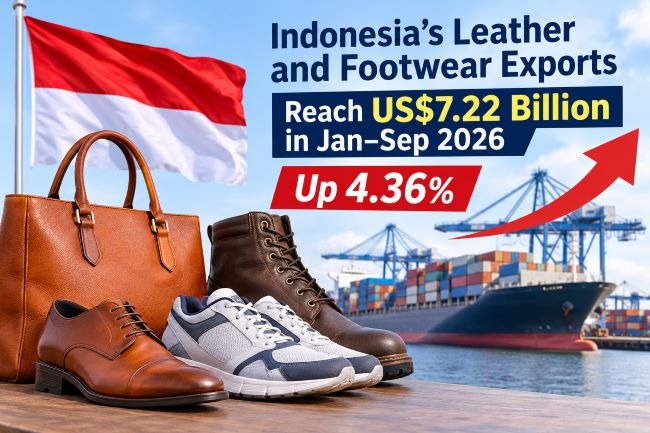
Indonesia's leather and footwear sector strengthens its export performance, with specialized footwear and creative leather products recording notable gains in global markets.
LW Desk
Indonesia’s leather and footwear industry recorded steady export growth during the first nine months of 2026, supported by strong demand for sports footwear, specialized shoes and creative leather products. Total exports reached US$7.22 billion, representing a 4.36% increase compared with the same period last year.
According to the Ministry of Trade, the performance reflects the sector’s continued competitiveness in international markets despite changing global trade conditions.
Trade Minister Budi Santoso highlighted product quality, innovation and value addition as key priorities for sustaining export growth and strengthening Indonesia’s position in the global leather and footwear industry.
Sports footwear remained the largest contributor, generating US$3.14 billion in export revenue between January and September.
Specialized footwear, including safety shoes, boots, medical and orthopaedic footwear, and tactical boots, recorded exports of US$2.05 billion, increasing 6.7% year on year. The category delivered the largest additional export value, contributing US$129.10 million compared with the corresponding period in 2025.
Creative leather products also performed strongly, with exports rising 13.3% to US$1.06 billion, generating an additional US$125.05 million in revenue.
The United States remained Indonesia’s leading export destination, accounting for 40.40% of total sector exports. Shipments to the market reached US$2.92 billion, up 9.24%. Exports to the Netherlands increased 16.40% to US$751.40 million, while China, Japan and Belgium recorded US$390.10 million, US$371.30 million and US$332.10 million, respectively.
To sustain this momentum, the Ministry of Trade is encouraging exporters to utilize existing trade agreements to improve market access and reduce tariff barriers. The government is also strengthening international promotion, business matching and connections between Indonesian manufacturers and overseas buyers.
With growth across key product categories and established export markets, Indonesia aims to further expand its leather and footwear trade and strengthen its global market presence through the end of 2026.